AI visibility becomes useful when a team can inspect the answer behind a metric and understand what changed. This guide turns that principle into a practical operating approach.
KEY TAKEAWAYS
The short version
- AI visibility ranks brands inside answers, not pages: it covers mentions, citations and how the answer positions you against competitors.
- Start with a fixed prompt set of 30 to 50 real buyer questions and run it across every AI engine your buyers use, so every change is measured against the same baseline.
- Entity consistency, answer-first page structure, comparison pages and third-party reviews are the signals AI engines lean on when choosing which brands to name.
- Own-site citations matter: in one study of 34,960 answers, brand mention rates rose from roughly 3% to 49% to 58% when the brand's own site was cited.
- Treat AI visibility as an ongoing program with an owner, 2 to 3 KPIs and a regular review tied to Search Console and pipeline data.
Introduction
Figuring out how to improve brand visibility in AI search engines is now a core priority for marketing and SEO teams, not a side experiment. AI search engines like ChatGPT, Gemini, Claude, Perplexity and Google AI Overviews have become real discovery channels for B2B buyers, and they increasingly answer questions directly instead of sending users to a list of links. If your brand is absent from those answers, you are invisible at the exact moment a prospect is forming a shortlist.
Visibility in AI search is fundamentally different from traditional SEO rankings. AI visibility is how often your brand is mentioned in AI answers, whether your domain is cited, and how favorably the answer positions you against competitors. AI visibility ranks brands inside answers, not pages, and a strong organic ranking does not guarantee a place in an AI-generated response.
To improve brand visibility in AI search engines, you need to do three things: audit where and how your brand appears today across AI platforms, strengthen the core signals AI systems rely on to mention, cite and recommend brands, and measure changes continuously against competitors.
This guide focuses on practical, evidence-based tactics for B2B marketing and SEO teams. It does not cover building AI models or general branding theory. Here is what you will walk away with:
- How to audit current AI visibility with a repeatable, fixed prompt set
- 9 specific tactics to earn more brand mentions and citations in AI-generated answers
- How to connect AI visibility data to Google Search Console and site performance
- How to benchmark against competitors across multiple AI engines
- How to monitor, iterate and report AI visibility over time
Understanding AI Search Visibility
AI search visibility refers to whether and how your brand is included in responses generated by AI search engines. It is not about ranking first in a list of blue links. It is about being part of the generated narrative when a buyer asks a question like “best AI visibility tools for agencies” or “how to track brand mentions across ChatGPT and Gemini.” AI visibility measures brand mentions, citations and recommendations in AI-generated responses.
This distinction matters because AI-generated responses often remove the need to visit a website at all. The buyer gets a synthesized answer, a short list of named brands, and sometimes a handful of source links. Getting into that short list is the goal.
What “brand visibility” means inside AI-generated answers
AI brand visibility breaks down into three measurable components:
- Brand mentions: your name appearing in the answer text, even without a link.
- Citations: your domain or specific product pages referenced or linked as a source.
- Positioning: how the AI describes your brand relative to competitors (for example “best for enterprise teams” versus listed fifth with no qualifier).
AI systems tend to present short lists when answering category or comparison questions, often only a handful of brands. Every additional inclusion meaningfully changes your brand's presence and share of voice.
Consider a hypothetical example. A user asks Gemini “best project management tools for construction firms,” and the answer reads: “Top options include BuildTrack, SiteFlow and Crewly. BuildTrack is best for general contractors managing multiple sites, while SiteFlow suits smaller teams.” BuildTrack has a mention, a positioning statement and potentially a citation. A brand absent from this answer has zero visibility for that query, regardless of its organic ranking.
How AI search engines decide which brands to show
AI search engines that browse the web typically work through four stages:
- Retrieval: the system queries its web index for relevant documents. AI crawlers must not be blocked in robots.txt, and content hidden behind JavaScript rendering or forms may be excluded entirely.
- Grounding: the system selects specific pages and passages to support its answer. Clarity, freshness, structured data and visible proof points like case studies all help.
- Synthesis: the system writes the answer, weaving together information from multiple sources.
- Citation: the system attaches source links showing which domains supported the answer.
The signals marketers can influence are substantial: clear entity definitions, consistent naming across the web, structured content with clear headings and concise answers, third-party reviews and authoritative citations. Your own site matters more than many teams assume. In an Aiso study of 34,960 AI answers, GPT mentioned the target brand in 49.0% of unbranded answers that cited the brand's own website, versus 2.8% when neither an own-site citation nor a branded search was present. For Gemini, the equivalent rates were 58.4% and 3.8%.
To improve visibility, teams must shift from “rankings for keywords” to “evidence AI can safely cite and summarize.”
From traditional SEO to Answer Engine Optimization (AEO)
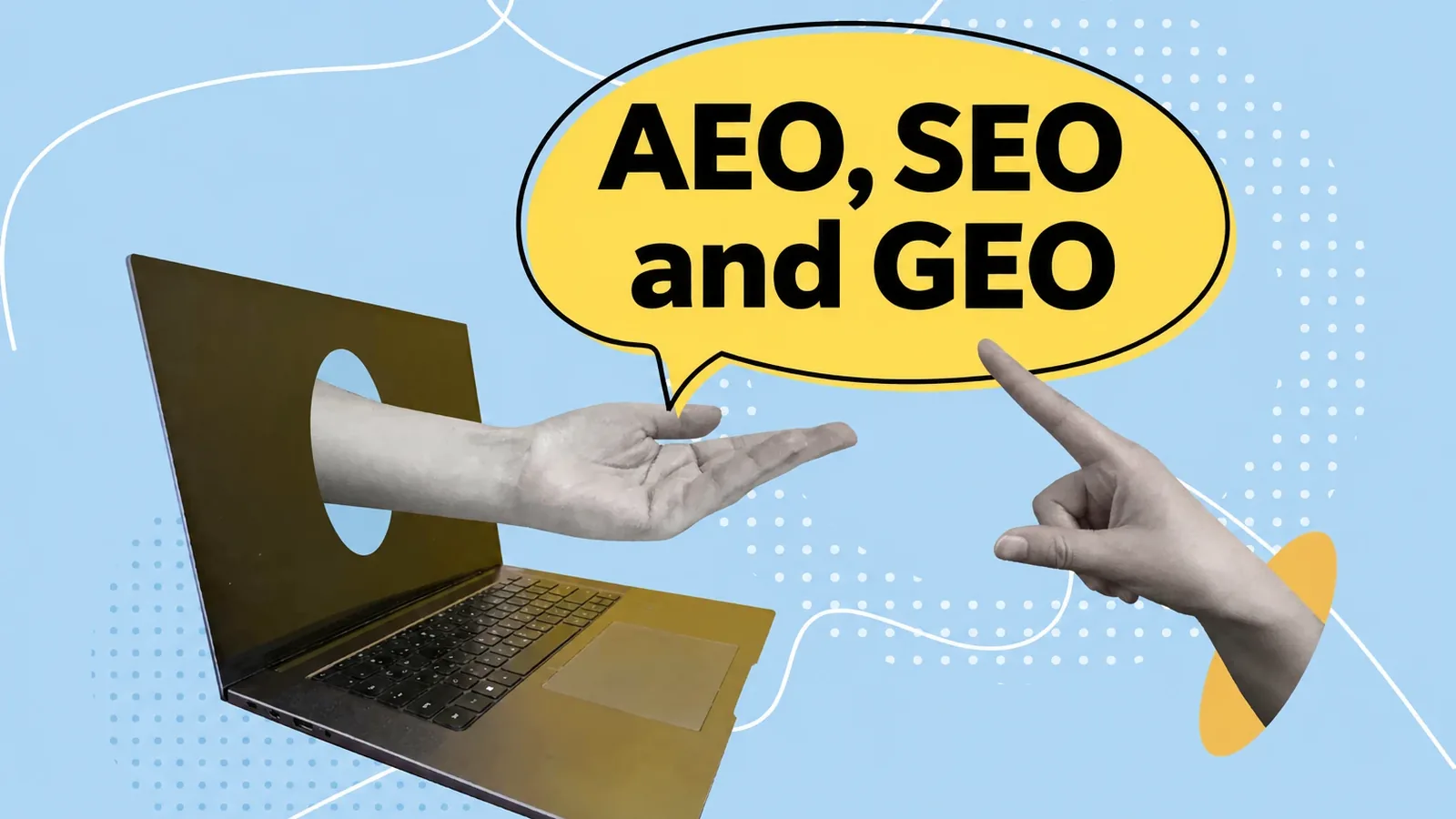
Answer Engine Optimization (AEO) is the practice of optimizing brands and content to be referenced in AI-generated answers across multiple AI search engines. If you want the full breakdown of how it relates to SEO and GEO, see our guide to AEO vs SEO vs GEO.
Traditional SEO metrics focus on rank, impressions and clicks. AEO introduces different visibility metrics:
- Mention rate: the percentage of tracked prompts where your brand appears in the answer.
- Citation rate: how often your content is referenced as a source in AI answers.
- AI share of voice: your brand's mentions or citations relative to the total across the tracked category, calculated as (brand mentions / total tracked-brand mentions) x 100.
- Sentiment: whether the AI describes your brand positively, neutrally or negatively.
The following sections translate AEO theory into 9 specific, repeatable tactics a marketing or SEO team can execute this quarter.
9 Ways to Improve Brand Visibility in AI Search Engines This Quarter
These nine tactics are concrete and operational. Each can be started within 30 to 60 days. They are ordered from foundational (measurement) to advanced (continuous monitoring), so teams can prioritize based on current maturity.
1. Build a fixed prompt set that mirrors real buyer questions
You cannot improve what you do not measure. Tracking a consistent library of prompts, rather than running ad hoc queries, creates a measurable baseline and lets you detect trends over time. Our guide to building a buyer-intent prompt library covers this in depth.
To build your prompt set:
- Interview sales, customer success and SDR teams to collect 30 to 50 recurring questions prospects actually ask.
- Group prompts across funnel stages: awareness (“what are the best AI visibility tools”), comparison (“[your brand] vs [competitor] for AI brand monitoring”), decision (“is [your brand] worth it for agencies”) and brand-specific (“what does [your brand] track”).
- Phrase prompts in natural language, the way a buyer would type them into ChatGPT or Perplexity.
Example prompts for a hypothetical B2B SaaS vendor:
- “Best platforms to track brand mentions in AI search engines”
- “How do I measure AI share of voice for my brand”
- “Alternatives to [competitor] for AI visibility monitoring”
- “How to improve AI search performance for B2B companies”
In one documented case, BiViSee used a fixed set of 120 commercially relevant prompts to track a mid-market company's AI visibility. The right number depends on your category breadth, but 30 to 50 is a practical starting range.
2. Run those prompts across all priority AI search engines
Once your prompt set is ready, test it across every AI engine that matters to your buyers:
- ChatGPT (web UI, latest flagship model)
- Google AI Overviews and AI Mode
- Gemini, Claude, Perplexity and Microsoft Copilot
For each engine, on the same date:
- Capture responses as raw text or screenshots.
- Repeat the run at least 3 times with the same prompt set to filter out random variation in AI responses.
- Record whether your brand is mentioned, cited, recommended or omitted entirely.
- Note which competitors appear and in what position.
This process is manual but gives a fast baseline in a single week, and it shows exactly which prompts surface your brand and which do not. Platforms like Aimate automate these checks, running the same prompt set across engines on a schedule and storing every answer as evidence.
3. Standardize brand entities and naming across the web
AI models need clear, consistent brand information across platforms to represent entities accurately. When brand names, product names and domains are inconsistent, AI systems may miss, merge or misattribute your brand.
A concrete checklist:
- Create a single, unambiguous brand entity description on your homepage and About page. Include the full name, short name and key category labels (for example “[Brand]: AI visibility monitoring platform for B2B marketing teams”).
- Align social bios, directory listings and profiles (LinkedIn, G2, Capterra, Crunchbase, Product Hunt) to use the same wording and category descriptors.
- Implement clean schema markup (Organization, SoftwareApplication, WebSite) so your brand is recognized as a distinct entity. Standard schema is enough; there is no special AI-only schema.
In the BiViSee case study, fragmented entity signals were identified as one of the main causes of weak AI visibility. After the fixes, the share of brand mentions that included a verifiable citation rose from 22% to 61%.
4. Rewrite key pages for extractable, answer-first content
AI engines favor clear headings and concise answers that are easy to parse. Most AI systems quote or paraphrase content that is easy to extract and summarize, and ranking first in traditional results is not sufficient on its own.
Here is how to optimize for extractability:
- Identify 10 to 20 highest-value pages: solutions pages, product overviews, comparison pages, FAQs and pricing explainers.
- Rewrite each with an answer-first structure: a 2 to 3 sentence answer to the core question at the top, followed by scannable subsections with headings, bullet lists and tables.
- Use clear, factual statements that AI can safely reuse (for example “[Brand] tracks brand mentions across ChatGPT, Gemini, Claude, Perplexity and Google AI Overviews”).
Before (vague): “Our platform gives you a complete picture of how you're performing online with advanced analytics and powerful reporting.”
After (extractable): “Aimate monitors AI brand visibility across ChatGPT, Gemini, Claude, Perplexity and Google AI Overviews. It tracks mention rate, citations and share of voice for every prompt in your library. Teams use it to find visibility gaps, benchmark competitors and connect AI visibility data to Google Search Console.”
The second version gives AI a clear picture of what the product does, who it serves and what it measures.
5. Publish comparison and alternatives pages that AI can cite
A large share of AI buyer prompts are comparison queries: “[brand] vs [competitor],” “best AI visibility tools for agencies,” “alternatives to [competitor].” AI search engines cross-reference multiple sources to build these answers, and comparison pages provide exactly the structured, factual content they need.
Action steps:
- Create honest, well-sourced comparison pages for your brand versus 3 to 5 direct competitors. Include feature tables, use cases, pricing ranges (where public) and who each tool is best for. Our own Aimate comparison pages follow this format.
- Publish “alternatives to [competitor]” pages where your product genuinely fits, using neutral, factual language AI can trust.
- Add citations and external references (for example G2 category badges or analyst reports) to strengthen credibility.
Kept up to date, these pages can become the sources AI engines rely on when answering comparison prompts in your category.
6. Strengthen third-party signals and reviews AI leans on
AI assistants frequently rely on trusted third-party sites rather than vendor copy alone. Consistent mentions across credible sources signal that a brand is established in its category.
Practical tactics:
- Prioritize 3 to 5 high-authority platforms in your category (G2, Capterra, TrustRadius, Gartner Peer Insights) and make sure your profiles are complete and accurate.
- Launch a targeted review program, asking satisfied customers for detailed, specific reviews on 1 to 2 priority platforms. Reviews that describe specific use cases and outcomes carry more weight than generic praise.
- Secure 3 to 5 in-depth case studies or interviews in credible industry publications and link them from your site's press section.
In a Fractl case study, a 12-month program combining content with sustained digital PR made a matchmaking service the most-cited brand in its category, earning 1,223 AI citations and roughly 295,000 monthly AI answer impressions, about five times the nearest competitor.
7. Expand high-intent FAQs and “how it works” content
AI systems tend to answer B2B queries with FAQ-like structures and conceptual overviews. FAQ content that provides direct answers maps well to how AI engines generate responses.
Steps:
- Mine support tickets, sales call notes and on-site search logs from the last 12 months for recurring “how” and “why” questions.
- Create or update FAQ hubs organized by topic (for example “AI visibility metrics,” “answer engine optimization workflow,” “AI share of voice”).
- Structure each FAQ with a direct, factual answer in 2 to 4 sentences, followed by optional deeper explanation.
- Use FAQPage schema markup where appropriate. It can help both traditional search results and AI Overviews source selection.
8. Connect AI visibility data with Google Search Console and analytics
Improving visibility in AI search engines should be linked to measurable downstream behavior. Without that connection, AI visibility work stays isolated from your other channels and hard to fund. Our guide to measuring ROI from AI search visibility covers the full framework.
Implementation guidance:
- Tag AI-referred sessions as a distinct channel in analytics where possible. Referrals from ChatGPT, Perplexity and Gemini are often identifiable, though some AI traffic arrives without a clean referrer.
- Align tracked prompts with key topics in Google Search Console to see whether improved AI visibility coincides with shifts in branded and non-branded queries. Google now reports performance for its generative AI search features for eligible properties.
- Set up a monthly review where marketing, SEO and demand-gen teams inspect AI answer samples alongside Search Console and CRM reports.
Aimate's Search Correlation feature maps AI visibility against Search Console data, helping teams see which prompts line up with changes in organic performance. See how to connect AI citations with Search Console performance for the method.
9. Set up continuous AI visibility monitoring and competitive benchmarking
AI answers change more quickly than traditional rankings, so one-off checks are not sufficient. Ongoing measurement shows which sources get cited and whether your changes are working.
Practical steps:
- Turn your fixed prompt set into a weekly or monthly monitoring routine across ChatGPT, Gemini, Claude, Perplexity and Google AI Overviews.
- For each prompt, track whether your brand appears, its position in the answer (first mentioned or lower), which competitors appear when you are absent, and which URLs are cited.
- Use these patterns to prioritize content updates each sprint. Focus on prompts where a single competitor dominates and you are fully absent.
Aimate automates this workflow by running curated prompt sets on a schedule, storing raw answers, and reporting mention rate, sentiment and share of voice over time, so teams can see how their brand and competitors perform across engines.
Designing a Repeatable Answer Engine Optimization Workflow
The 9 tactics above are not isolated tasks. They form a workflow that fits into existing SEO and content operations. Think of it as an evolution of your standard SEO process, not a separate discipline. The goal is to make AI visibility monitoring as routine as keyword research and rank tracking.
Step-by-step workflow for marketing and SEO teams
- Choose priority segments, regions and buyer personas. Start narrow: one product line, one geography, one buyer persona.
- Build and validate your prompt set with sales and customer teams. Aim for 30 to 50 prompts covering awareness, comparison and decision stages.
- Run baseline AI visibility checks and benchmark 3 to 5 competitors. Document where each brand appears and how often.
- Identify the 10 to 15 prompts with the largest opportunity gap: high buyer intent, low current visibility.
- Plan and execute content and entity fixes targeting those prompts, prioritized by expected impact and effort.
- Re-run prompts, log changes, and tie results to Search Console and pipeline metrics. Look for correlation between improved AI mentions and changes in organic traffic or demo requests.
- Institutionalize monitoring with a dedicated owner and regular reviews. AI visibility needs the same sustained attention as SEO rankings. A biweekly report is a good cadence.
This workflow translates directly into a quarterly plan, with each step mapping to a sprint or workstream alongside existing content and SEO cadences.
Choosing and using an AI visibility monitoring platform
When evaluating an AI visibility monitoring platform, look for:
- Multi-engine coverage: at minimum ChatGPT, Gemini, Claude, Perplexity and Google AI Overviews.
- Raw answer storage: not just summary scores. You need to see exactly what AI says about your brand and competitors.
- Brand, competitor and citation tracking across all tracked prompts.
- Answer-level reporting on mentions, sentiment and citations, so you know not just whether your brand appears but how it is described.
- Search Console integration to connect AI visibility with organic search performance.
Aimate is built around these requirements. It runs curated prompt sets across AI engines, stores every raw answer, tracks brand and competitor mentions, traces cited sources through Citation Intelligence, and connects results to Search Console data. Evidence Reports then turn that monitoring into a report the whole team can act on.
Common Challenges and How to Fix Them
Even with a clear workflow, teams run into predictable obstacles. Here are four challenges that stall AI visibility progress, and how to fix each one.
Challenge 1: Your brand never shows up for generic category prompts
Likely causes: weak or inconsistent category positioning on your own pages, sparse third-party coverage compared to incumbents, and a limited footprint in reviews, case studies and expert roundups.
Fix:
- Sharpen category language on core pages and profiles within one sprint, so AI can identify your category without ambiguity.
- Launch a focused PR and thought leadership push targeting 3 to 4 authoritative publications in your niche within a 90-day window.
- Monitor your top 10 awareness prompts monthly to detect when first brand mentions begin to appear.
In a GrowthPanda case study, a fintech brand went from zero citations across 10 tracked buyer prompts to being named in AI answers for all 10 within 90 days by focusing on this kind of category positioning work.
Challenge 2: AI answers mention you but recommend competitors
This is the pattern where your brand appears in long lists or descriptions, but AI explicitly highlights competitors as “best for X.” Your position in the answer is passive, not recommended.
Fix:
- Update product and comparison pages to clarify your strongest use cases, segments and differentiators in concrete terms (for example “best for agencies managing 10+ brands across multiple AI engines”).
- Add detailed, quantifiable proof: case study results, usage volumes, customer logos. AI can summarize specifics more easily than vague claims.
- Check and correct category descriptions on third-party sites that may understate your strengths.
Challenge 3: AI models repeat outdated or inaccurate information about your brand
Deprecated features still cited. Old pricing. Miscategorized products. If your product evolved but your content did not, AI will keep propagating the old version.
Fix:
- Identify which URLs AI is citing for those claims, using a citation tracking tool such as Aimate's Citation Intelligence or manual link inspection.
- Update or replace outdated content on your own domains, and request corrections from external publishers with a concrete, fact-based change request.
- Create a clearly dated “What's new” or “Product updates” page that summarizes key product and pricing changes in plain language.
- Re-check affected prompts 4 to 8 weeks after fixes to confirm the answers have changed.
Challenge 4: Internal teams treat AI visibility as a side project
Scattered, ad hoc ownership leads to stalled progress. No one is responsible for reviewing answers, logging changes or closing the loop.
Fix:
- Assign a single owner, usually within SEO or digital strategy, with explicit accountability for AI visibility metrics.
- Define 2 to 3 core KPIs: AI mention rate for your top 20 prompts, AI share of voice versus 3 key competitors, and number of corrected misstatements per quarter.
- Integrate AI visibility review into existing SEO and content planning cadences rather than creating a parallel process. AI visibility data should sit next to keyword and organic traffic reports.
Conclusion and Next Steps
Improving brand visibility in AI search engines comes down to generating better evidence, structuring it so AI can extract and reuse it, and measuring inclusion and sentiment across engines over time. Strong AI visibility is not built through a single tactic. It comes from consistent entity clarity, extractable content, third-party proof and continuous monitoring tied to business outcomes.
The 9 tactics in this guide can be implemented incrementally. Start with a fixed prompt set and a baseline audit. You do not need to overhaul your entire content strategy in week one.
A practical plan for your next 30 days:
- Week 1: Build your prompt library (30 to 50 prompts) and select your priority AI engines.
- Week 2: Run a baseline audit across engines and document competitor visibility.
- Week 3: Fix entity clarity on core pages and rewrite 5 to 10 critical pages for extractability.
- Week 4: Launch review and third-party profile updates, and set up ongoing monitoring.
To automate this workflow, start a free 7-day trial of Aimate. It tracks brand mentions across ChatGPT, Gemini, Claude, Perplexity and Google AI Overviews, stores raw AI answers, monitors competitor visibility, and connects AI visibility metrics with Google Search Console data.